Ceramic5 min read
Face gua sha vs body gua sha: which do you need?
How the face gua sha and the body gua sha differ in shape, size and use, and how to choose a tool, or a set, for your own ten-minute ritual.
By GO:GYEOL
Not every gua sha is made for the same job. A face tool and a body tool share one idea, a smooth ceramic edge drawn in slow strokes, but their shapes are made for very different places. If you are deciding between the two, this guide explains what each tool is, where it is used, and when a set makes more sense than a single tool.
Which gua sha should you buy?
Choose the face gua sha if your ritual is about the neck, jaw, cheeks and brow. Choose the body gua sha if you want long strokes along the legs, arms, shoulders and stomach. Choose both, as the Face & Body Duo, if you would like one ritual from head to toe.
The face gua sha
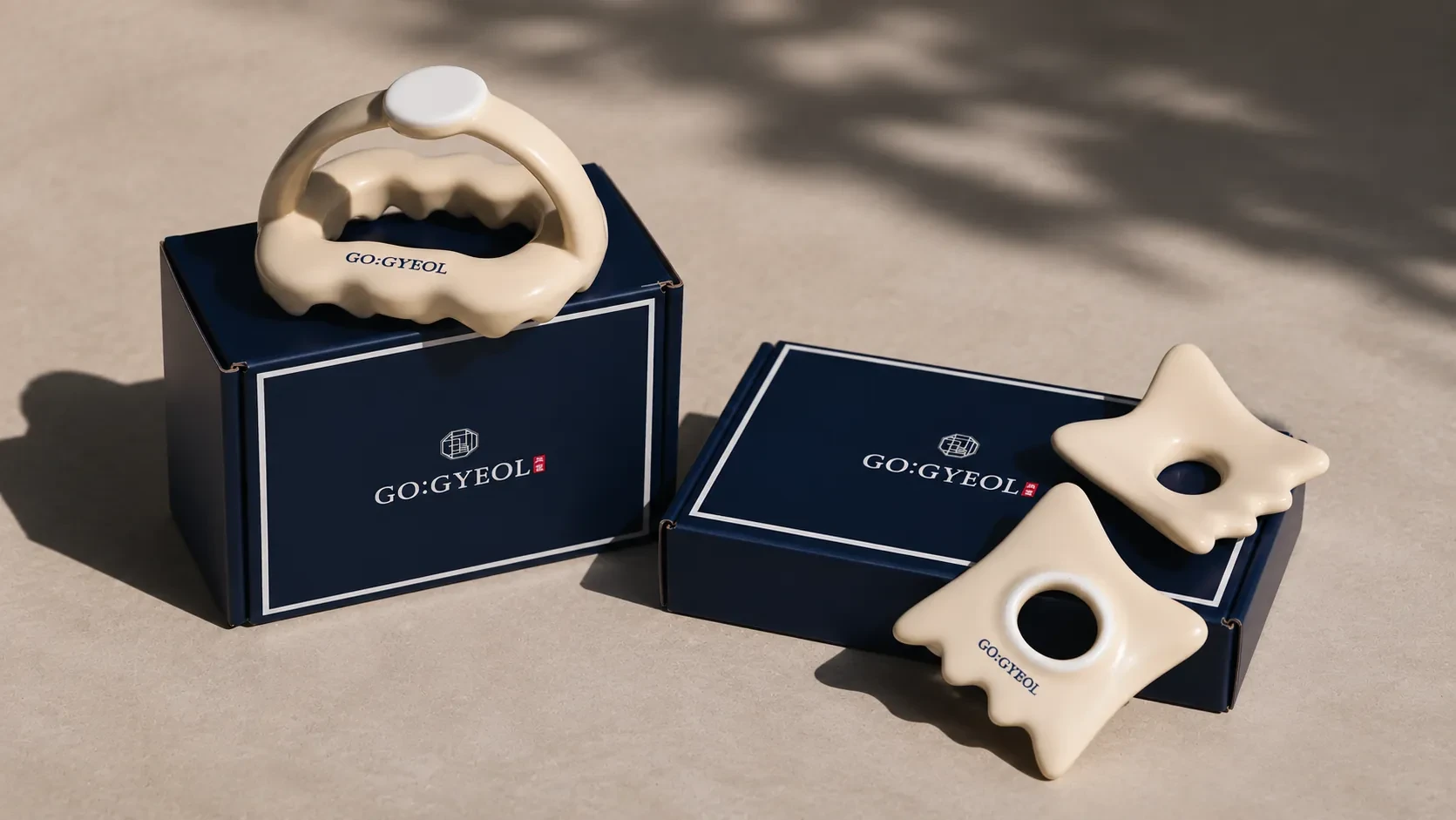
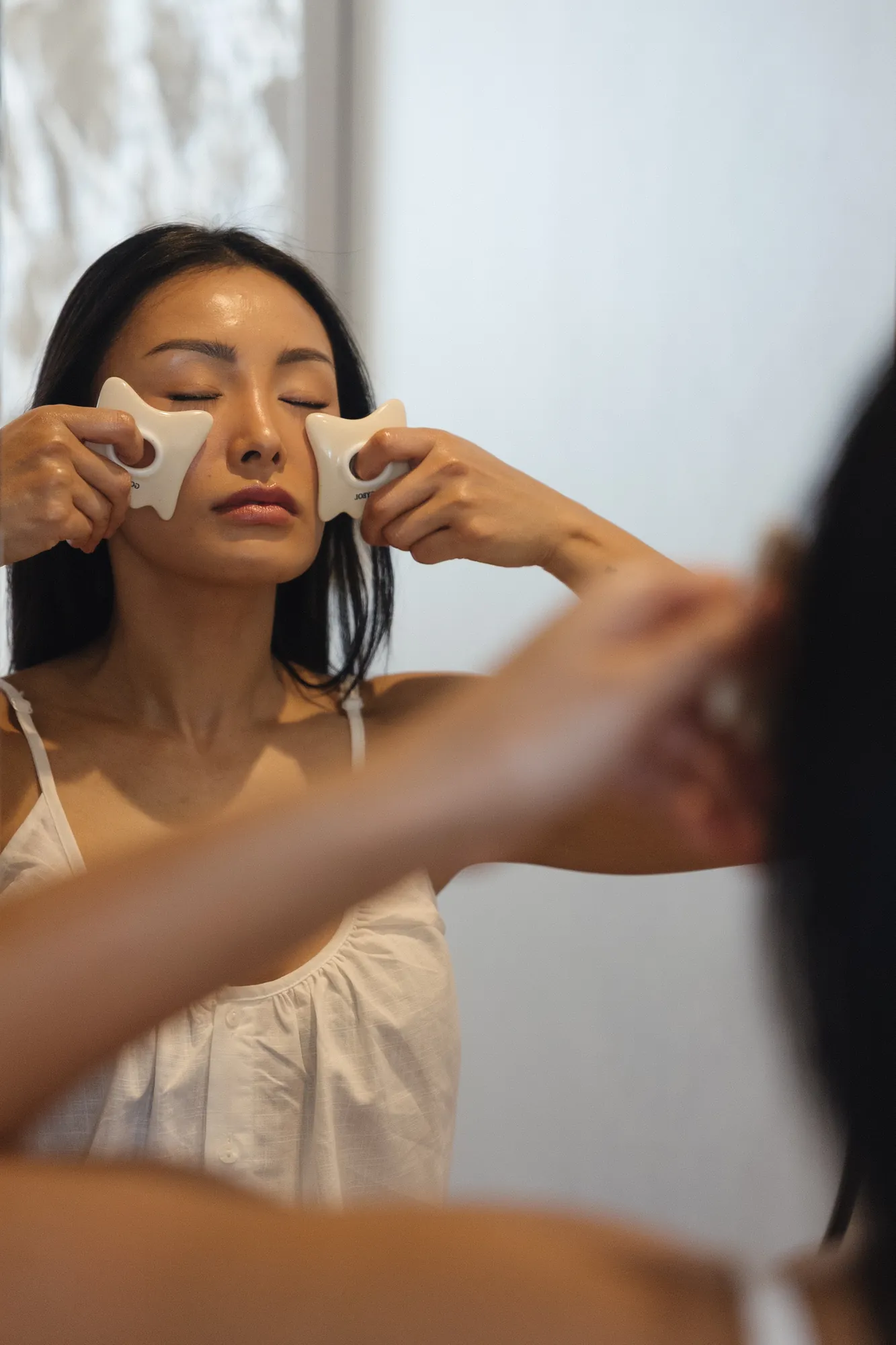
The GO:GYEOL Facial Sculpt Ceramic Gua Sha comes as a pair of white glazed ceramic tools. Each one has soft curved edges, a wave-edged side and a centre thumb hole for an easy hold, and each is sized to sit comfortably in the hand.
Because it comes as a pair, you can work both sides of the face at once, in matching strokes: one tool in each hand, moving outward from the centre. The curved edges follow the line of the jaw and cheekbone, and the wave-edged side is made for slow strokes along the scalp.
On the face, slow strokes help depuff, ease tension in the jaw and neck, and lift and contour, so skin looks sculpted and awake.
Where to use the face gua sha
- Neck and collarbone
- Jawline
- Cheeks
- Brow and forehead
- Scalp
The body gua sha
The GO:GYEOL Body Sculpt Ceramic Gua Sha is larger and weighted, with a double wave-edged ring and a centre palm grip, finished in gradient tan and cream. Its wave-edged ridges glide in long, rolling strokes, and the palm grip lets you hold it with your whole hand for even, steady pressure across larger areas.
The ring can also be slipped over the fingers, which makes it comfortable for working around the knee and along the forearm.
On the body, long strokes help ease and release muscle tension and boost circulation, so skin feels smooth, firm and invigorated. In East Asian tradition, body gua sha has long been used to support lymphatic drainage.
Where to use the body gua sha
- Back and shoulders
- Arms
- Stomach
- Thighs and legs

How do face and body gua sha differ?
- Shape: the face tools have soft curves, a wave-edged side and a thumb hole; the body tool has a wave-edged ring and a palm grip.
- Size: the face tools sit in the fingers; the body tool fills the palm.
- How many: the face gua sha is a pair; the body gua sha is a single tool.
- Strokes: shorter, outward strokes on the face; long, upward strokes on the body.
- Glide: a face oil or serum on the face, or the Nourishing Balm in the evening; the balm or a body oil on the body.
Can you use a face gua sha on the body?
You can use the face tools on smaller areas such as the collarbone, the wrists and the backs of the hands, but their size makes long strokes on the legs slow going. The body tool is the opposite: it is made for broad areas and is too large for the fine work around the eyes and nose. That is why many people end up keeping both.
Which set is right for you?
- Face Ritual Set: the face gua sha pair and the Nourishing Balm.
- Body Ritual Set: the body gua sha and the Nourishing Balm.
- Face & Body Duo: both ceramic tools, for face and body.
- Complete Ritual Set: the face pair, the body tool and the Nourishing Balm, the full ritual in one set.
If you are starting with one tool, start with the area you will actually come back to each day. Most people begin with the face pair, because the face ritual fits into ten minutes at the bathroom mirror, and add the body tool later.
Why are both tools ceramic?
We make both tools from glazed ceramic because it can be shaped precisely, it stays cool to the touch, and its sealed surface wipes clean with warm water and mild soap. It is the material we chose for the whole GO:GYEOL ritual. Gua sha itself comes from Chinese tradition; what we bring is a slow-beauty way of practising it, guided by the Korean word 고결: purity, grace and a higher standard of care in everyday things.
Whichever tool you choose, the ritual is the same: ten minutes, neck first, slow strokes. Our guide to how to use a gua sha walks through every step, our care guide covers cleaning and storage, and the ritual page shows the order for face and body. For what the studies say, read our article on the research behind gua sha.
Frequently asked questions
Is the face gua sha sold as a pair?
Yes. The Facial Sculpt Ceramic Gua Sha comes as two tools, so you can work both sides of the face at once, in matching strokes.
Can I use the body gua sha on my face?
The body tool is made for broad areas such as the legs, arms and back. For the neck, jaw, cheeks and brow, use the face pair.
Which tool should I start with?
Start with the area you will come back to each day. Many people begin with the face pair and add the body tool later, or choose the Face & Body Duo to have both from the start.
What should I use for glide?
On the face, a face oil or serum, or the GO:GYEOL Nourishing Balm in your evening ritual. On the body, the balm or a body oil. The tool should glide, not drag.
How do I care for both tools?
Rinse each tool under warm water with a little mild soap after every use, pat it dry and store it flat or in its pouch.