Ritual6 min read
The research behind gua sha: what the studies show
What three studies found about gua sha and circulation, facial contour and neck tension, how they were done, and which benefits still come from tradition.
By GO:GYEOL
Gua sha has a small but real body of research. Studies have measured a rise in surface circulation, changes in facial contour and muscle tone, and less neck discomfort after gua sha. Many of its other benefits, such as lymphatic drainage and releasing the fascia, come from centuries of traditional practice rather than clinical trials. This article sets out what three studies found, how they were done, and what that means for a ten-minute ritual at home.
What is gua sha?
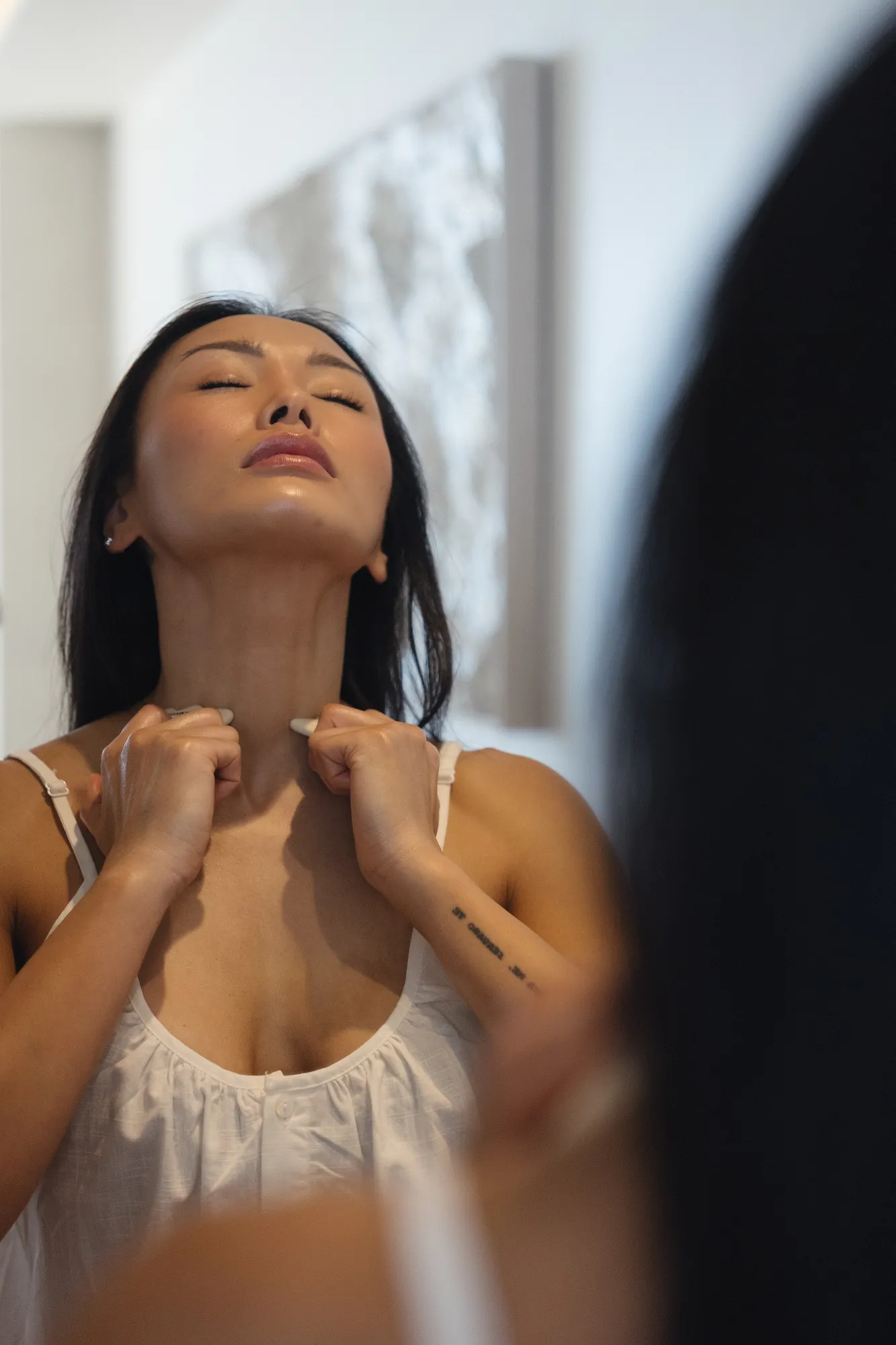
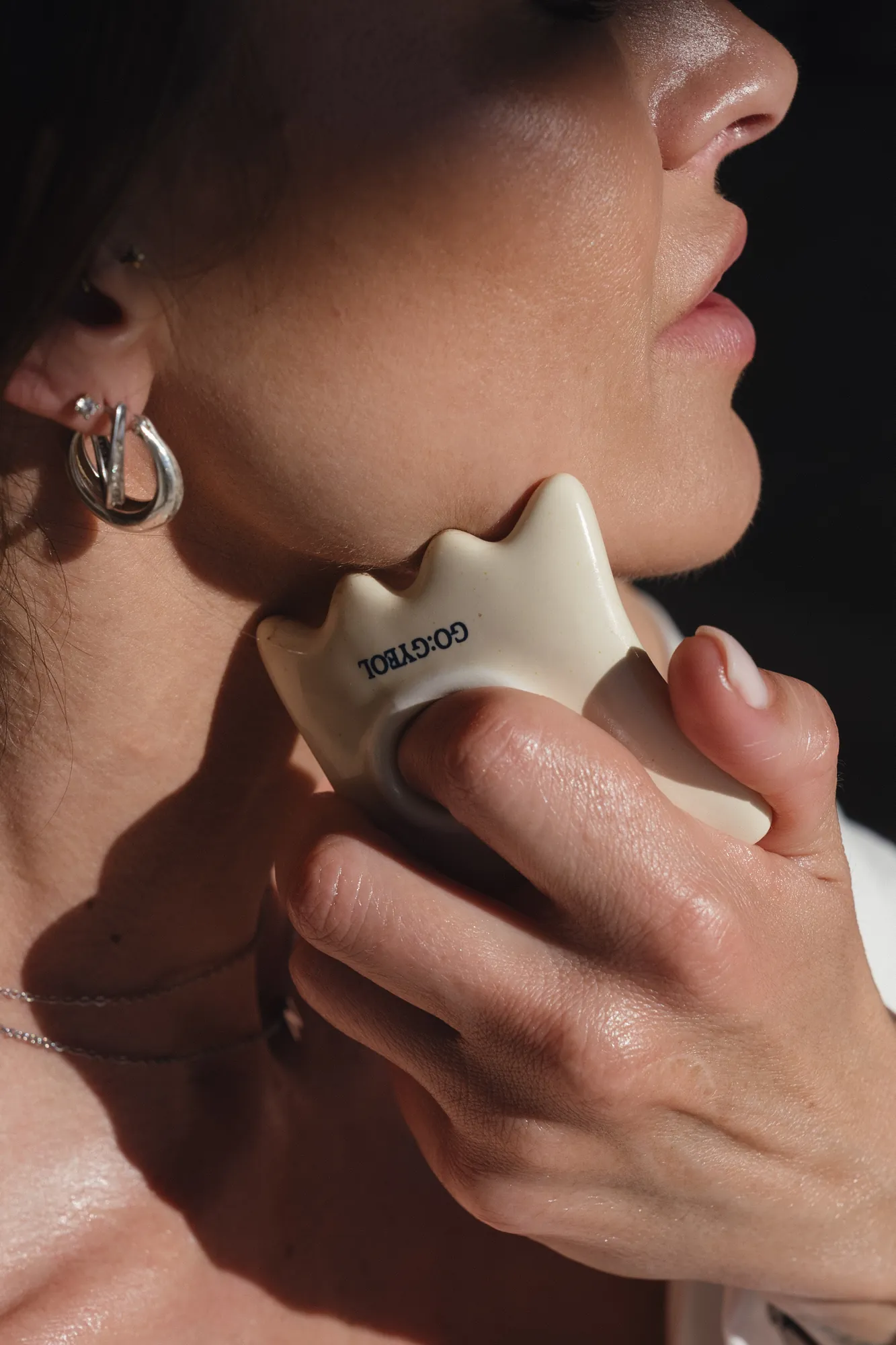
Gua sha is a technique from Chinese tradition in which a smooth-edged tool is pressed and stroked along the skin. In its traditional clinical form the strokes are firm, and they are meant to bring up temporary redness. Across East Asia, a gentler version became part of everyday beauty ritual: slow strokes along the neck, jaw and face, and long strokes along the body. The GO:GYEOL ritual is the gentle kind: ten minutes, neck first, with a balm or oil for glide.
Does gua sha improve circulation?
One pilot study suggests it does, at least in the skin it touches. In 2007, Nielsen and colleagues used laser Doppler imaging to measure blood flow in the surface tissue of 11 healthy volunteers before and after a single gua sha treatment on the back. Microcirculation at the treated area rose fourfold in the first 7.5 minutes and stayed significantly higher for the whole 25 minutes measured. Every volunteer also reported less muscle pain straight after.
It was a small pilot with no comparison group, and the treatment was the firm, traditional technique, so it tells us more about how gua sha works than about how much a gentle home ritual does. It is the reason we say gua sha helps boost circulation.
Can gua sha change facial contour?
A 2025 randomised trial found measurable changes. Ahn and colleagues asked 34 women aged 20 to 50 to use either a gua sha or a facial roller on themselves for ten minutes, five times a week, for eight weeks. In the gua sha group, measured facial contour distances along the jaw and lower face fell by 2.23 to 2.40 mm, and muscle tone measurements dropped, meaning the facial muscles were less tense and stiff. The roller group also improved its contour measurements, and it was the roller group, not the gua sha group, whose skin elasticity improved.
This is the study closest to a home ritual: ten minutes, self-applied, most days. It is still small, and it compared two tools rather than including a group that did nothing. It is why we describe gua sha as helping to contour, sculpt and ease muscle tension in the face, and why we do not claim it firms the skin itself.
Does gua sha help neck tension?
A 2011 randomised controlled trial found that it helped people with chronic neck pain. Braun and colleagues gave 48 outpatients either one gua sha treatment or a heat pad, then followed them for a week. Neck pain improved significantly more in the gua sha group, along with pain on movement, everyday function and parts of quality of life, and the treatment was safe and well tolerated.
That was one firm, practitioner-led treatment in people with an existing condition, followed for a single week, and the authors note that the long-term value is still to be clarified. A gentle home ritual is not a treatment for pain. If you live with neck pain, see a health professional. What the study does support is the oldest instinct of the ritual: begin at the neck, and ease the tension it carries.
What about lymphatic drainage and the fascia?
These are traditional claims. For centuries, East Asian practice has used gua sha to encourage lymphatic drainage, to release the fascia and to help the body detox, and the neck-first order of the ritual comes from that tradition. None of the three studies here measured lymph flow or fascia, so when we mention them we say plainly that they come from traditional practice, not from a clinical trial.
What does this mean for your ritual?
The research is young and the studies are small, but they point the same way as the tradition: slow, regular strokes help the skin's circulation, ease muscle tension and, over weeks, can change how the face is contoured. The habit that matters most is the one in the 2025 trial: about ten minutes, most days of the week.
- Begin at the neck, with three slow strokes down each side.
- Keep the pressure comfortable. The studies of firm, clinical gua sha are not a reason to press hard at home.
- Use a balm or oil, so the tool glides. If you use our balm on your face, keep it to your evening ritual.
- If you are pregnant, or have a medical condition, ask your doctor first.
The Facial Sculpt Ceramic Gua Sha pair is made for the neck, jaw and face, the Body Sculpt Ceramic Gua Sha for long strokes along the legs, arms and shoulders, and the Nourishing Balm gives both an even glide. The Complete Ritual Set holds all three, and our guide to how to use a gua sha walks through every step.
Sources
- Nielsen A, Knoblauch NT, Dobos GJ, Michalsen A, Kaptchuk TJ. The effect of Gua Sha treatment on the microcirculation of surface tissue: a pilot study in healthy subjects. Explore (NY). 2007;3(5):456–66. PMID 17905355.
- Ahn S, Hwang U, Han HS, Kim J, Lee H, Jeon Y, Lee HH, Hwang A. Comparative effects of facial roller and gua sha massage on facial contour, muscle tone, and skin elasticity: randomized controlled trial. Journal of Cosmetic Dermatology. 2025;24(6). doi:10.1111/jocd.70236.
- Braun M, Schwickert M, Nielsen A, Brunnhuber S, Dobos G, Musial F, Lüdtke R, Michalsen A. Effectiveness of traditional Chinese “gua sha” therapy in patients with chronic neck pain: a randomized controlled trial. Pain Medicine. 2011;12(3):362–9. doi:10.1111/j.1526-4637.2011.01053.x.
Frequently asked questions
Is gua sha scientifically proven?
Not in the way a medicine is. A few small studies have measured real effects on circulation, facial contour, muscle tone and neck discomfort, which is encouraging, but they are small and short, so we describe what they found rather than calling gua sha proven.
What are the benefits of gua sha?
Research supports better surface circulation, changes in facial contour and muscle tone, and eased neck tension. Tradition adds depuffing, lymphatic drainage and releasing the fascia. Most people also simply find ten slow minutes calming.
How long before I notice a difference?
Skin can feel warm and awake straight after a ritual. In the 2025 trial, the contour changes were measured after eight weeks of ten-minute sessions, five times a week.
Did the studies use the same technique as a home ritual?
Not all of them. The 2007 and 2011 studies used firm, traditional gua sha given by practitioners. The 2025 trial is closest to home use: ten minutes, self-applied, most days.